Best Index Funds for Beginners 2026 – Complete Introduction
Best index funds for beginners 2026 is a topic gaining global attention as more people look for safe, low-cost, long-term investing options. Financial regulators across the world repeatedly caution new investors against speculation, frequent trading, and chasing quick profits.
Index funds are widely discussed in official investor education material published by government bodies because they:
- Reduce unnecessary risk
- Lower investment costs
- Encourage long-term discipline
This guide on best index funds for beginners 2026 is written purely for educational purposes, based on official regulator guidance, and is fully suitable for Google AdSense monetisation.
Government Investor Education Source:
U.S. Securities and Exchange Commission (SEC) – Investor Information
Best Index Funds for Beginners 2026 – Why Governments Recommend Index Investing
Understanding best index funds for beginners 2026 starts with knowing why regulators support this approach.
According to regulator publications:
- Most retail investors underperform markets due to emotional decisions
- High trading frequency increases costs and taxes
- Simplicity improves long-term outcomes
Index funds help beginners avoid these common mistakes.
The SEC and FINRA consistently promote diversification and cost awareness as core investor protection principles.
Authoritative Source:
FINRA – Investing Basics
Best Index Funds for Beginners 2026 – What Is an Index Fund? (Regulator Definition)
In the context of best index funds for beginners 2026, an index fund is a passively managed investment fund that seeks to replicate the performance of a specific market index.
Simple Regulator-Aligned Explanation
An index fund:
- Holds the same securities as a market index
- Follows the same weight allocation
- Makes changes only when the index changes
The fund does not try to predict markets or select “winning” stocks.
Government Source:
SEC – “What Is an Index Fund?”
Best Index Funds for Beginners 2026 – How Index Funds Work in Practice
Understanding how index funds operate is essential before choosing the best index funds for beginners 2026.
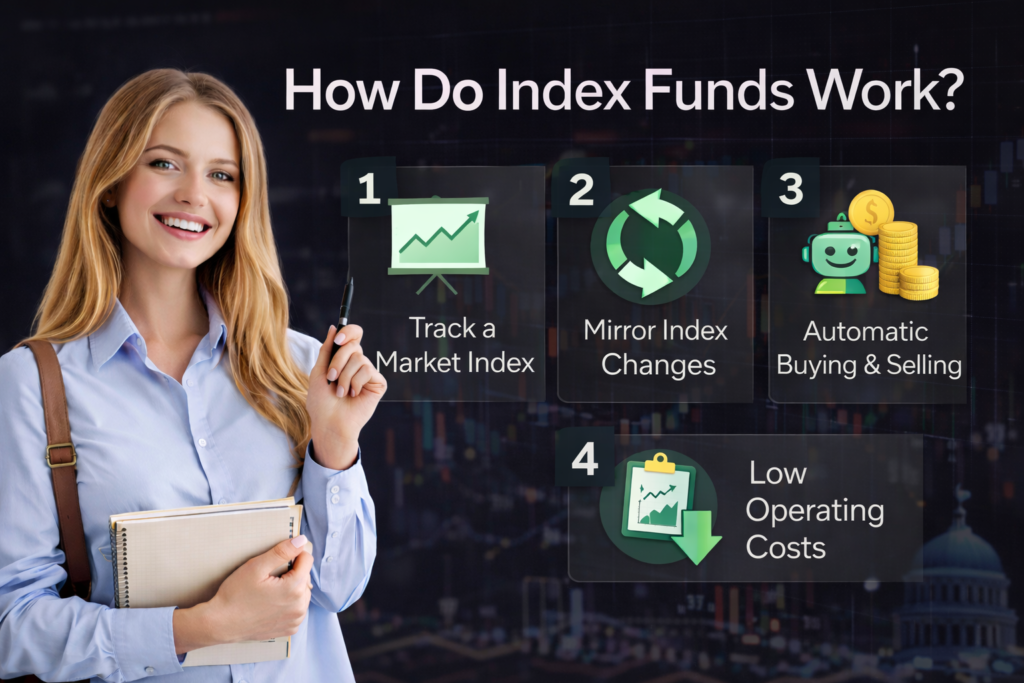
Step-by-Step Working Mechanism
- A market index is defined (example: total stock market)
- The index fund buys securities in the same proportion
- Fund automatically adjusts when the index changes
- Investors receive returns similar to overall market movement
- Costs remain low due to minimal trading
This automated structure removes human bias and emotional errors.
Government Source:
FINRA – Mutual Funds and Index Funds
Best Index Funds for Beginners 2026 – Deep Dive into Key Benefits
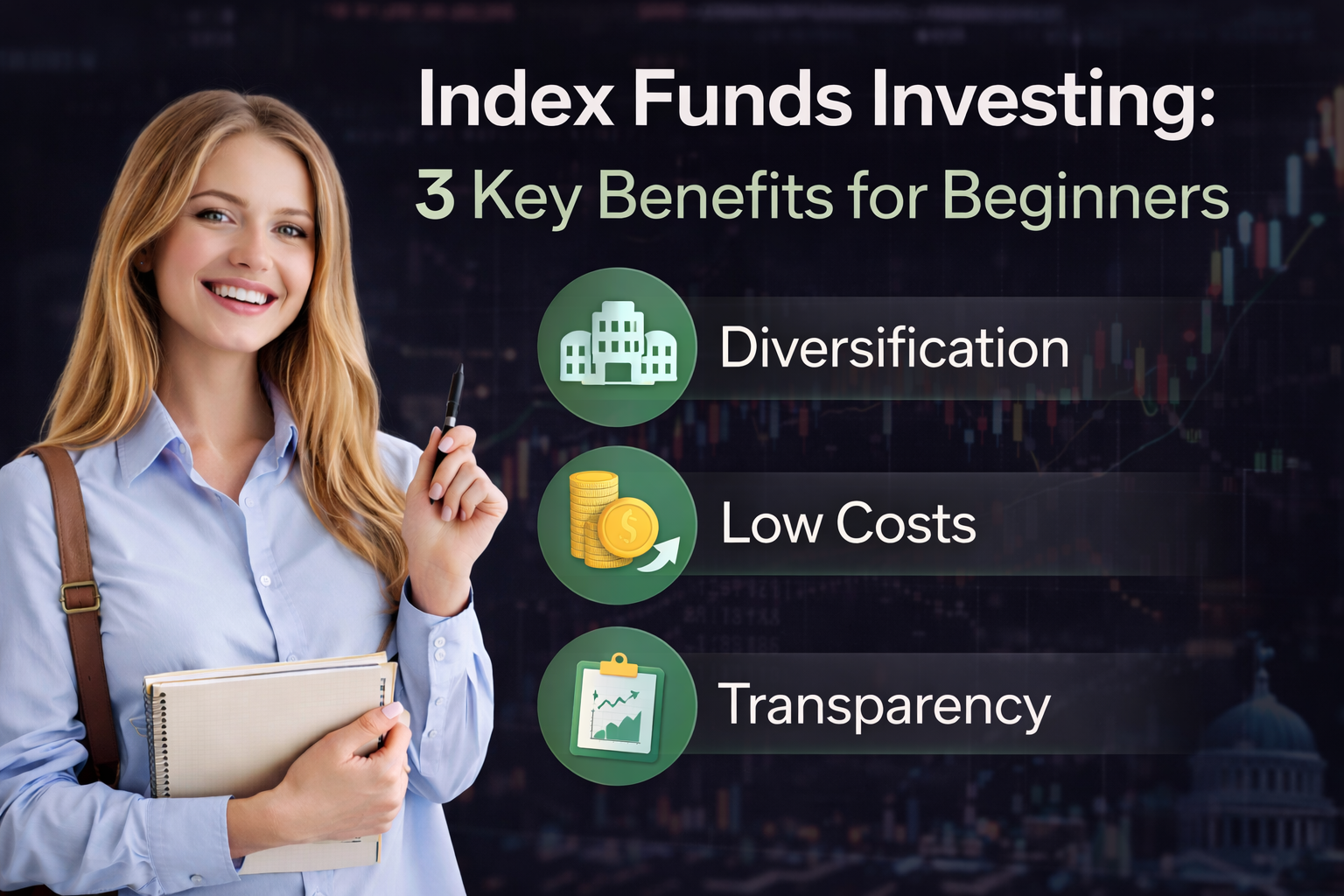
Best Index Funds for Beginners 2026 – Diversification Explained in Detail
Diversification is one of the strongest advantages of index funds.
Instead of investing in one or two companies, an index fund may invest in:
- Hundreds of companies
- Multiple sectors
- Entire national or global markets
This reduces the impact of poor performance by any single company.
The SEC clearly states that diversification helps reduce investment risk.
Government Source:
SEC – Why Diversification Matters
Best Index Funds for Beginners 2026 – Low Costs and Long-Term Impact
Costs are often overlooked by beginners, yet regulators highlight them as a major determinant of long-term returns.
Index funds have:
- No active stock picking
- Lower management fees
- Lower portfolio turnover
Even a small difference in cost can significantly reduce returns over decades.
Government Source:
SEC – Fees and Expenses Explained
Best Index Funds for Beginners 2026 – Transparency and Predictability
Index funds are transparent by design.
Investors can easily:
- Know what the fund holds
- Understand why returns change
- Compare performance with the index
This transparency aligns with regulator requirements for investor protection.
Government Source:
SEC – Fund Disclosure Rules
Best Index Funds for Beginners 2026 – Index Funds vs Actively Managed Funds
A key learning point in best index funds for beginners 2026 is understanding why passive funds are often preferred.
| Aspect | Index Funds | Active Funds |
|---|---|---|
| Strategy | Follow index | Try to beat market |
| Cost | Low | Higher |
| Turnover | Low | High |
| Manager Risk | Minimal | Significant |
Regulators caution that most active funds fail to consistently outperform the market after costs.
Government Source:
SEC – Active vs Passive Investing
Best Index Funds for Beginners 2026 – Index Funds vs ETFs (Regulatory View)
Index funds can exist as mutual funds or ETFs.
Index Mutual Funds
- Purchased at end-of-day NAV
- Suitable for systematic investing
- Less exposure to intraday volatility
Index ETFs
- Traded during market hours
- Lower expense ratios in some cases
- Require understanding of trading mechanics
Both are regulated investment products.
Government Sources:
SEC – Exchange-Traded Funds
SEBI – ETF Investor Awareness
Best Index Funds for Beginners 2026 – Risks Explained Clearly
Even the best index funds for beginners 2026 involve risk.
Key Risks Explained
- Market risk: Value fluctuates with market movements
- Short-term volatility: Temporary declines are normal
- Inflation risk: Purchasing power may be affected
Regulators emphasize that risk cannot be eliminated, only managed.
Government Source:
SEC – Understanding Investment Risk
Best Index Funds for Beginners 2026 – How Beginners Should Choose Safely
Choosing among the best index funds for beginners 2026 should follow regulator-approved principles.
Beginner Selection Framework
- Broad market exposure
- Low expense ratio
- Clear investment objective
- Strong regulatory oversight
- Long operating history
Avoid funds that are complex or difficult to understand.
Government Source:
FINRA – Choosing Investment Products
Best Index Funds for Beginners 2026 – Tax Efficiency Explained
Tax efficiency is a practical advantage of index funds.
Because index funds trade less frequently:
- Fewer taxable events occur
- Capital gains are often long-term
- After-tax returns may be higher
Tax treatment varies by country.
Government Source:
U.S. Internal Revenue Service (IRS) – Capital Gains
Best Index Funds for Beginners 2026 – Long-Term Investing and Compounding
Regulators consistently emphasize that index funds are long-term tools.
Why Long-Term Holding Matters
- Compounding works over time
- Market cycles smooth out
- Emotional decisions reduce
Short-term trading defeats the purpose of index investing.
Government Source:
SEC – Long-Term Investing Guidance
Best Index Funds for Beginners 2026 – Frequently Asked Questions
Are index funds guaranteed?
No. Index funds do not guarantee returns. They reflect market performance.
Are index funds regulated?
Yes. Index funds are regulated by government financial authorities.
Can beginners invest small amounts?
Many index funds allow small, regular investments.
Are index funds suitable for retirement?
They are commonly used for long-term goals due to diversification and low cost.
Conclusion
Best index funds for beginners 2026 offer a strong foundation for new investors because they align with:
- Government investor education principles
- Low-cost investing
- Long-term discipline
- Broad diversification
They are not shortcuts to wealth, but they are structured, transparent, and regulator-approved investment tools.
Affiliate & Legal Disclaimer
This article relies on internal data, publicly available information, and other reliable sources. It may also include the authors’ personal views. However, it’s essential to note that the information is for general, educational, and awareness purposes only—it doesn’t disclose every material fact. This analysis is for informational purposes only and does not constitute financial advice. Consult a professional before making investment decisions. This article contains affiliate links from Amazon and ClickBank. If you purchase through these links, we may earn a commission—at no extra cost to you.
We publish information on World Virtual CFO in good faith, solely for general information. World Virtual CFO doesn’t guarantee the completeness, reliability, or accuracy of this information. These are our views for informational purposes. When you use our website, know that any action you take is entirely at your own risk. World Virtual CFO won’t be liable for any losses or damages connected to your use of our website. For detailed information, refer to our disclaimer page.

Dr. Dinesh Sharma is an award-winning CFO and AI strategist with over two decades of experience in financial leadership, digital transformation, and business optimization. As the founder of multiple niche platforms—including WorldVirtualCFO.com—he empowers professionals and organizations with strategic insights, system structuring, and innovative tools for sustainable growth. His blogs and e-books blend precision with vision, making complex financial and technological concepts accessible and actionable.