Introduction: The 2026 Pivot Toward a BRICS Digital Currency Linkage
As of Sunday, January 25, 2026, the global financial landscape is witnessing its most significant shift since the Bretton Woods Agreement. The BRICS digital currency linkage has moved from a conceptual talking point to a formal policy recommendation. Reports confirmed on January 19, 2026, that the Reserve Bank of India (RBI) has officially nudged the Indian government to place the interlinking of Central Bank Digital Currencies (CBDCs) on the formal agenda for the 2026 BRICS Summit.
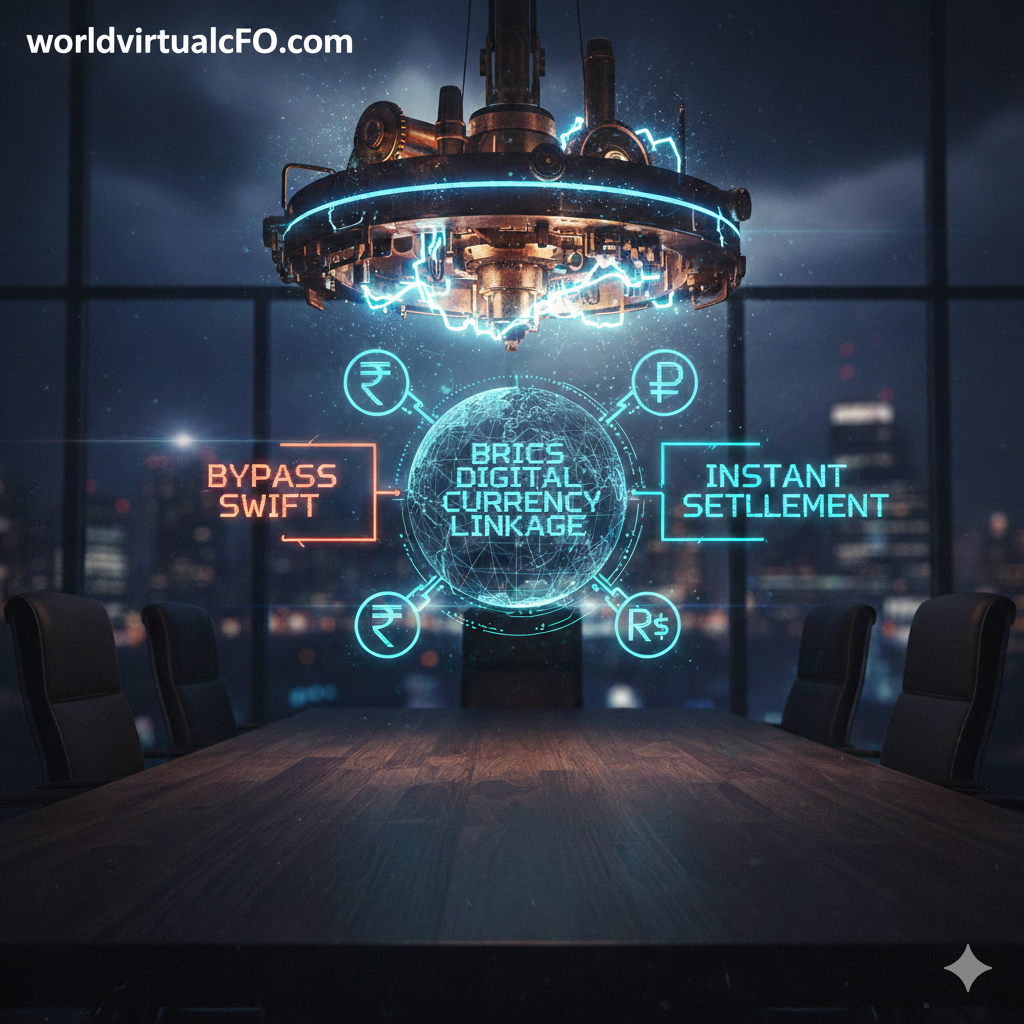
For the readers of World Virtual CFO, this is not merely a geopolitical headline. The BRICS digital currency linkage represents a structural change in how international trade is settled. By connecting the digital versions of the Rupee, Yuan, Real, and Ruble, the bloc aims to create a “T+0” (instant) settlement layer that operates independently of the US dollar-dominated SWIFT system. This is the “Industrialization of De-dollarisation,” and it starts with the digital infrastructure of the Global South.
- 1. What is the BRICS Digital Currency Linkage?
- 2. Why the RBI is Pushing the BRICS Digital Currency Linkage Now
- 3. Status of CBDCs in the BRICS+ Bloc (January 2026)
- 4. Challenges to the BRICS Digital Currency Linkage
- 5. FAQ: Understanding the BRICS Digital Currency Linkage
- Conclusion: The CFO’s 2026 Mandate
- Affiliate & Legal Disclaimer
1. What is the BRICS Digital Currency Linkage?
The BRICS digital currency linkage is a proposed technological framework designed to ensure interoperability between the sovereign digital currencies of member nations. Unlike traditional “correspondent banking,” which relies on a chain of intermediary banks, this linkage allows for direct, peer-to-peer settlement between central bank ledgers.
The Technical Architecture
The linkage is expected to build upon the lessons learned from Project mBridge, a multi-CBDC platform that reached its “Minimum Viable Product” (MVP) stage in mid-2024.
- Wholesale CBDC Exchange: Banks can exchange wholesale digital tokens directly, bypassing the need for a third-party reserve currency like the USD.
- DLT-Based Settlement: Utilizing Distributed Ledger Technology (DLT), the platform ensures that transactions are immutable, transparent, and settled in real-time.
- Liquidity Pools: To manage trade imbalances—such as the recent accumulation of surplus Rupees by Russia—the BRICS digital currency linkage will likely utilize bilateral foreign exchange swap arrangements settled on a weekly or monthly basis.
2. Why the RBI is Pushing the BRICS Digital Currency Linkage Now
The timing of the RBI’s proposal is strategic. India assumed the BRICS presidency on January 1, 2026, and will host the leaders’ summit later this year.
Strategic Motivations
- Lowering Transaction Frictions: Traditional SWIFT transfers can take 3–5 days and cost up to 7% in fees. A BRICS digital currency linkage can reduce these costs to near-zero.
- Trade Resilience: Geopolitical tensions have led to the “weaponization of finance.” A parallel digital rail ensures that BRICS trade—now exceeding $500 billion annually—remains uninterrupted by Western sanctions.
- Monetary Sovereignty: By using digital currencies, central banks can “program” money. For example, trade grants or subsidies can be programmed with specific conditions, ensuring funds are used for their intended purpose.
Official Resource: Stay updated on the latest Indian digital currency developments via theReserve Bank of India (RBI) Official Website.
3. Status of CBDCs in the BRICS+ Bloc (January 2026)
To understand the viability of the BRICS digital currency linkage, we must look at the current state of the national digital currencies involved.
| Country | Digital Currency Name | 2026 Status |
| India | e-Rupee (e₹) | 7 Million+ Retail Users; Wholesale Pilot expanding. |
| China | e-CNY | World’s most advanced pilot; $2.3 Trillion+ volume. |
| Russia | Digital Ruble | Broad commercial pilot; focused on cross-border trade. |
| Brazil | Drex | Advanced pilot phase with focus on tokenized assets. |
| UAE | Digital Dirham | Active participant in mBridge cross-border pilots. |
4. Challenges to the BRICS Digital Currency Linkage
Despite the momentum, the BRICS digital currency linkage faces significant hurdles that CFOs must account for in their risk assessments.
- Technological Sovereignty: Member nations are often reluctant to adopt technology platforms designed by rivals. For the linkage to work, the “BRICS Bridge” must be a neutral, decentralized platform.
- Regulatory Harmonization: Each nation has different laws regarding data privacy, Anti-Money Laundering (AML), and Know Your Customer (KYC) protocols.
- Trade Imbalances: As seen in the 2024-2025 trade between India and Russia, the accumulation of “idle” local currency is a risk. The BRICS digital currency linkage must solve this through automated swap lines or “basket-based” settlement assets.
5. FAQ: Understanding the BRICS Digital Currency Linkage
How will the BRICS digital currency linkage affect the US Dollar?
While the RBI states its goal is “efficiency,” the linkage naturally reduces the global demand for USD in bilateral trade. By bypassing the dollar for $500B+ in annual trade, the bloc weakens the dollar’s “exorbitant privilege” in specific trade corridors.
Is this a “Common BRICS Currency”?
No. Unlike the Euro, the BRICS digital currency linkage does not replace national currencies. It is a “bridge” that allows national digital currencies to talk to each other directly.
What is the difference between this and Stablecoins?
The BRICS digital currency linkage uses CBDCs, which are state-backed liabilities of a central bank. Stablecoins (like USDT or USDC) are private liabilities. The RBI has explicitly warned that stablecoins pose “systemic risks” and prefers the regulated CBDC model for institutional trade.
When will the linkage be fully operational?
Following the 2026 Summit, technical working groups are expected to launch bilateral pilots. A full-scale, multi-lateral BRICS digital currency linkage is realistically targeted for 2027-2028.
Conclusion: The CFO’s 2026 Mandate
The BRICS digital currency linkage is the most consequential financial infrastructure project of the decade. For the readers of cfostimes.com and worldvirtualcfo.com, the message is clear: the diversification of global payment rails is no longer optional.
As India takes the lead in 2026, corporate treasuries must prepare for a future where a significant portion of Global South trade occurs on digital ledgers. By understanding the BRICS digital currency linkage now, you are positioning your organisation to capitalise on faster settlement speeds, lower fees, and enhanced financial sovereignty.
Affiliate & Legal Disclaimer
This article relies on internal data, publicly available information, and other reliable sources. It may also include the authors’ personal views. However, it’s essential to note that the information is for general, educational, and awareness purposes only—it doesn’t disclose every material fact. This analysis is for informational purposes only and does not constitute financial advice. Consult a professional before making investment decisions. This article contains affiliate links from Amazon and ClickBank. If you purchase through these links, we may earn a commission—at no extra cost to you.
We publish information on World Virtual CFO in good faith, solely for general information. World Virtual CFO doesn’t guarantee the completeness, reliability, or accuracy of this information. These are our views for informational purposes. When you use our website, know that any action you take is entirely at your own risk. World Virtual CFO won’t be liable for any losses or damages connected to your use of our website. For detailed information, refer to our disclaimer page.
Transparency: This pillar post is 100% human-authored and fact-checked against official data from the Bank for International Settlements (BIS) and the RBI.
Financial Disclosure: This content is for informational purposes and does not constitute financial advice. For official guidance, refer to the Bank for International Settlements (BIS) CBDC Hub.

Dr. Dinesh Sharma is an award-winning CFO and AI strategist with over two decades of experience in financial leadership, digital transformation, and business optimization. As the founder of multiple niche platforms—including WorldVirtualCFO.com—he empowers professionals and organizations with strategic insights, system structuring, and innovative tools for sustainable growth. His blogs and e-books blend precision with vision, making complex financial and technological concepts accessible and actionable.